
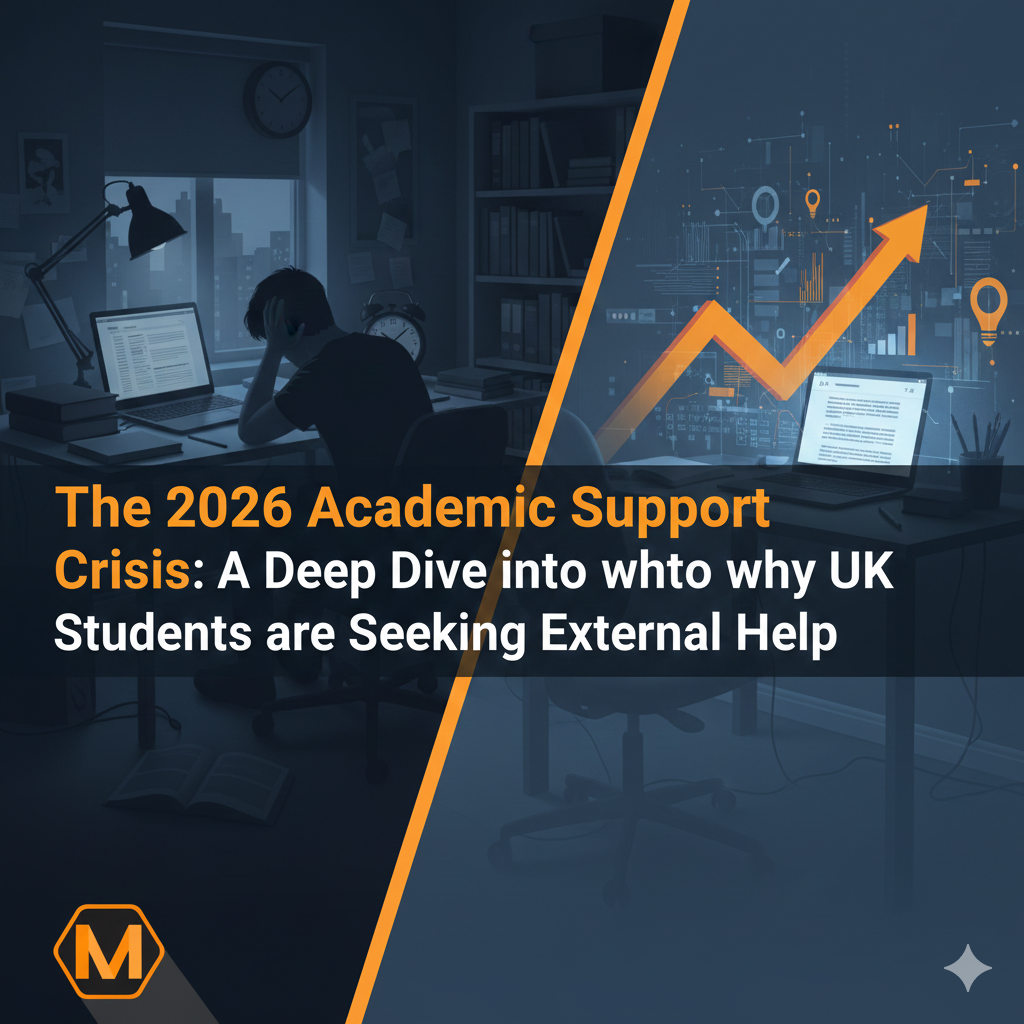
The British higher education sector is currently navigating a period of profound transformation. As we move through the 2025/26 academic year, the traditional “ivory tower” experience has been replaced by a high-pressure environment defined by economic volatility and digital acceleration. According to the Higher Education Policy Institute (HEPI), the “Value for Money” perception among students has hit a record low, not due to teaching quality, but due to the sheer impossibility of balancing academic rigour with survival.
In this climate, the “Rise of Academic Support” is not merely a trend—it is a survival mechanism. This report explores the socio-economic drivers behind the increasing reliance on external academic assistance and the evolving role of the modern student.


1. The “Time Poverty” Epidemic: Working to Learn
The primary driver of the shift toward external support is “Time Poverty.” For the first time in UK history, the 2025 Student Academic Experience Survey confirmed that the average undergraduate now spends more time in paid employment than in independent study.
With maintenance loans failing to keep pace with inflation (which saw a cumulative 11% gap in purchasing power over the last three years), 68% of UK students are now employed during term time. When a student is working 20+ hours a week in the service sector just to cover rising rents in cities like Manchester, Bristol, or London, the 40-hour “full-time” study week becomes a mathematical impossibility.
Consequently, the demand for UK assignment help has surged. Students are not looking to bypass learning; they are looking to manage a cognitive load that has become physically unsustainable. By utilizing professional support for literature reviews and structural outlining, students can focus their limited “brain bandwidth” on their core exams and practical placements.
2. The Psychology of “Degree Inflation” and Perfectionism
The 2026 job market is more competitive than ever. With the proliferation of “First Class” degrees, the “2:1” (Upper Second-Class) has become the absolute minimum for entry into Graduate Schemes at firms like PwC, Deloitte, or the Civil Service. This has created a culture of “perfectionism or bust.”
Data from the Office for Students (OfS) indicates that student anxiety regarding “failing to meet potential” has risen by 40% since 2022. This psychological weight often leads to chronic writer’s block. To break this cycle, many students look to pay for essays online specifically to receive “model papers.” These papers act as a high-level rubric, showing the student exactly how to synthesize complex arguments—a form of scaffolding that overstretched university tutors can no longer provide in 1-on-1 sessions.
3. The Institutional Gap: Why Universities are Losing the Support Race
UK universities are facing a funding crisis. With home tuition fees frozen for years while operational costs soared, the staff-to-student ratio in many Russell Group institutions has widened. The result?
- Waiting lists: 3–4 weeks for a feedback session with a lecturer.
- Generic Feedback: Automated or “copy-paste” feedback on drafts that doesn’t help the student improve.
- Overwhelmed Libraries: A lack of access to core physical and digital texts during peak deadline seasons.
External academic services have filled this “support vacuum.” Unlike the university system, these services provide 24/7 availability and instant feedback, mirroring the “on-demand” nature of the modern digital economy.
4. International Student Dynamics: The High-Stakes Investment
The UK remains the second-most popular destination for international students globally. However, for a student from India, Nigeria, or China, a UK degree is a massive financial investment, often funded by entire extended families. With international fees now reaching upwards of £38,000 per annum, the cost of “failure” (or even a “2:2” grade) is financially ruinous.
Furthermore, the Skills and Post-16 Education Act 2022 has forced the industry to evolve. In 2026, the most reputable services function more like “private research consultancies.” They help international students navigate the specific nuances of British Academic English, which differs significantly from American or International English standards.
5. Ethical AI vs. Human Expertise
The 2024–2026 period saw the “AI Revolution” hit academia. While tools like ChatGPT can generate text, they often hallucinate facts and lack the critical “British perspective” required for UK Law, Nursing, or History degrees.
Students have learned that generic AI is a “trap” that leads to academic misconduct hearings. This has led to a flight toward human-led academic support. Modern students are willing to pay a premium for “AI-Free” content that features:
- Primary Source Analysis: Referencing actual UK statutes or NHS guidelines.
- Critical Synthesis: Moving beyond “what” happened to “why” it matters—the hallmark of a First-Class grade.
- Authentic Voice: Matching the specific tone and style required by UK department rubrics.
Comparative Analysis: Student Support 2020 vs 2026
| Feature | 2020 (Pre/Mid-Pandemic) | 2026 (Modern Era) |
| Primary Stressor | Social Isolation | Financial Survival (Rent/Energy) |
| Avg. Part-time Wage | £9.50/our | £12.50/hour (but higher COL) |
| Support Method | Library Study Groups | Professional Online Consultancy |
| Technology | Basic Zoom Lectures | AI-Integrated Learning Platforms |
| Degree Goal | Graduation | Top 10% Placement for Jobs |
Conclusion: The Future of the UK Degree
The rise of academic support is a symptom of an education system that is “over-capacity.” Until the UK government addresses the maintenance loan gap and university funding models, students will continue to act as rational economic agents. In 2026, seeking help is no longer about “laziness”—it is about professionalizing one’s approach to increasingly difficult academic hurdles.
The challenge for the next decade will be integrating these external supports into the university framework to ensure that success is based on talent, not just the ability to survive on four hours of sleep.
References
- Higher Education Policy Institute (2025). The Student Academic Experience Survey.
- UK Parliament (2025). House of Commons Library: Student Loans and Cost of Living Report.
- National Union of Students (NUS) (2026). Working to Survive: The 2026 Student Employment Report.
- Quality Assurance Agency (QAA) (2024). Academic Integrity in the Age of AI.
- Save the Student (2025). National Student Accommodation Survey.
Frequently Asked Questions (FAQs)
Q. What is the legal status of academic support in the UK?
The 2022 Act made “commercial essay mills” illegal in England. However, the law distinguishes between “cheating services” and legitimate academic assistance such as private tutoring, proofreading, and the provision of model answers for research purposes.
Q. How do students ensure their work is original?
In 2026, top-tier providers issue comprehensive “Originality Suites,” including a Turnitin-style report and an AI-transparency certificate, ensuring that the work is 100% human-generated and plagiarism-free.
Q. Why is “Time Poverty” affecting grades?
Research by TASO (2025) found a direct correlation between hours worked in retail/hospitality and a decline in final degree classifications. Students working over 16 hours a week are 12% less likely to achieve a First-Class degree without external support.
Q. Can I get in trouble for using these services?
Universities discourage the use of third-party work for final submissions. Students are advised to use professional services as a learning aid—to understand how to structure an argument or find relevant sources—rather than submitting the work as their own.
About the Author
Dr. Helena Whitaker is a Senior Research Fellow in Educational Sociology and a leading voice in British pedagogical research. Over the last decade, she has focused her investigative work on the critical intersection of student economics and academic performance. Her extensive research into the UK’s “Cost of Learning” crisis examines how financial instability is reshaping degree outcomes and student mental health. In addition to her academic publishing, she serves as a consultant for MyAssignmentHelp, where she advises on developing ethical support frameworks that align with the rigorous standards of the UK Higher Education sector.